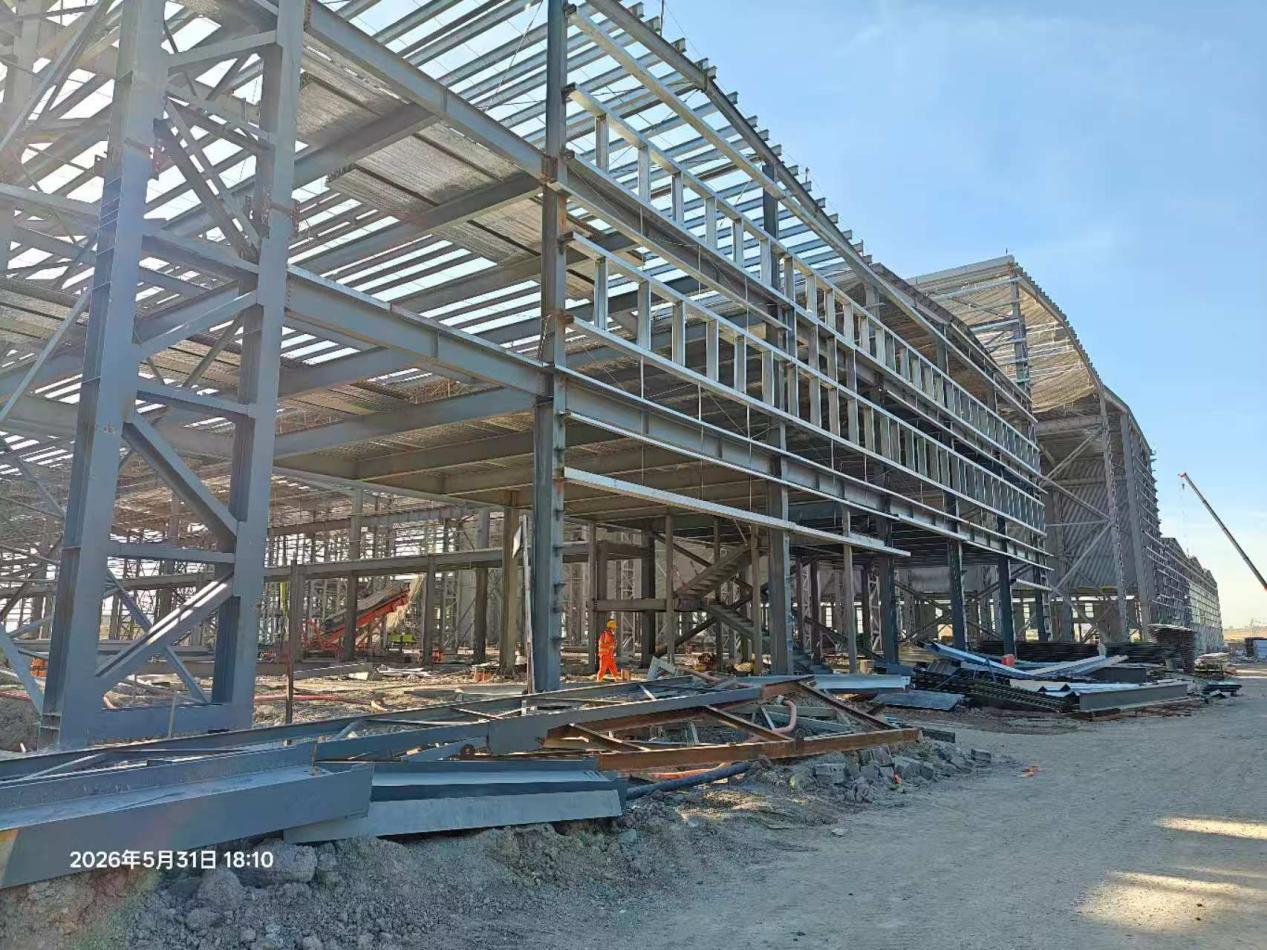
The Morocco branch of SWS Group undertook the steel-structure plant works for BTR's integrated cathode-and-anode materials base in Morocco. Located in the Mohammed VI Tangier Tech City within the Tangier Free Zone and adjacent to Tanger-Med port, it is North Africa's first large-scale integrated lithium-battery cathode/anode materials base.
Basic Project Information
- Positioning: North Africa's first large-scale integrated lithium-battery cathode/anode materials base and a core overseas capacity hub in BTR's global layout. It supports Gotion's 20 GWh battery factory in Morocco and builds a complete local "materials-to-cell" lithium-battery chain.
- Location: Mohammed VI Tangier Tech City, adjacent to Tanger-Med port. Sea freight to Spain takes just over 10 hours, and products can be exported to Europe under Morocco-EU free-trade arrangements.
- Project entities: BTR Mediterranean New Material Technology Co., Ltd. for the 50,000 t/yr cathode project and BTR Mediterranean Anode New Material Technology Co., Ltd. for the 60,000 t/yr anode project, both wholly owned by BTR.
- Milestones: The cathode investment agreement was signed in March 2024, the cathode project started construction in April 2024, and the anode integration project was announced in August 2024. The anode project is planned to start production in Q2 2026; Phase 1 of the cathode project is planned to start production in September 2026 and reach 50,000 t/yr by the end of 2026.
Investment and Capacity Plan
The 50,000 t/yr lithium-battery cathode materials project has a total investment of about USD 489 million and is planned in two phases. Its product routes include high-nickel ternary cathode materials and lithium iron phosphate cathode materials for passenger-vehicle power batteries and energy-storage batteries.
The 60,000 t/yr integrated lithium-battery anode materials project has a total investment of about USD 360 million. It focuses on 60,000 t/yr of fast-charging artificial graphite anode materials and includes silicon-based anode production lines, with localized processes including granulation, graphitization, and coating.
The two factory areas cover about 486,000 square meters in total. Combined investment is about USD 849 million, with total cathode/anode capacity of 110,000 t/yr. At full capacity, the base can support battery demand for around 500,000 new-energy vehicles, with projected annual revenue of about USD 1.2 billion.
Products and Target Customers
Cathode products include high-nickel ternary and lithium iron phosphate materials, while anode products include fast-charging artificial graphite, low-expansion natural graphite, and silicon-carbon anode materials. The base serves premium long-range vehicle and energy-storage applications. It will supply European automakers such as Volkswagen, BMW, and Ford, while also supporting Gotion's local battery factory in Morocco to form an on-site supply chain.
Around 90% of output is targeted at the EU market, with a smaller share supplied to North Africa and Middle East energy-storage markets, and broader regional reach supported by free-trade arrangements.
Core Competitive Advantages
Morocco's abundant phosphate resources help reduce transport cost for lithium iron phosphate cathode raw materials. Local wind and solar resources also support compliance with EU battery carbon-footprint expectations. Direct shipping from Tanger-Med port to major European ports can shorten logistics cycles and reduce inventory and transport costs compared with shipment from China.
The project creates upstream and downstream synergy with the Gotion power-battery factory in the same park, forming a closed-loop local "materials-to-cell" supply chain and improving sourcing efficiency for European automakers.
Value of the Steel Structure Works
The integrated cathode/anode base has long process flows, heavy equipment loads, and high requirements for coordination between factory areas. This places demanding requirements on plant span, load capacity, node precision, and construction organization. SWS used its steel-structure plant detailing and construction capabilities to provide high-standard main structures for granulation, graphitization, sintering, warehousing, and supporting logistics.
Industrial and Strategic Significance
The project strengthens BTR's overseas capacity layout across Indonesia in Southeast Asia and Morocco in North Africa, improving localized supply capability for the European market. It also fills a gap in high-end lithium-battery materials manufacturing in North Africa, driving mining, chemical, logistics, and local employment development while supporting Morocco's new-energy industry upgrade.
Localization and Green Manufacturing
The project plans to establish a local technical training system and promote localization of management and technical teams. The factory area is planned with self-use photovoltaic power and low-energy processes, aligning with green-factory requirements and EU green-battery regulation trends.
